Experiment on Negative Impedance Converter and Gyrator

Objectives

  • To find the frequency response of a simple Negative Impedance Converter
  • Study of the Gyrator circuit and its application in synthesizing Inductors


Prerequisites

Other basics: [ CROBread-board connectionCapacitor, Inductor ]


Experiment Steps

Follow the procedure as given in the manual.

Estimation of Fourier Coefficients of a Periodic Signal

Prerequisites


  • Fourier Transform and Fourier Series
  • Fourier series approximation of square wave
  • Nonlinear elements
  • V-I characteristics of diode

Experiment Steps

Follow the procedure as given in the manual.


What do you observe?

The circuit given here acts as a filter. Find out which type of filter it is, by using its frequency response.
Now, you know that this circuit produces high gain at a certain frequency.

For different combination of L and C, the frequency at which maximum gain occurs changes. What do you infer from that?


Active Low Pass Filter

It uses an Op-amp to realize an active filter.
The cutoff frequency (in hertz) is defined as:

$ f_c = \frac{1}{2\pi R_2 C}$

The gain in the passband is −R2/R1, and the stopband drops off at −6 dB per octave (that is −20 dB per decade) as it is a first-order filter.

Cathode Ray Oscilloscope (CRO)

Cathode Ray Oscilloscope or simply CRO is an electronic instrument which provides visual representation or graph of any waveform applied to its input terminals.


Working principle of CRO

Cathode Ray Tube or CRT is the main part or heart of a CRO. It is used to bombard electrons towards the fluorescent screen. CRT is an evacuated tube where an electron gun is fitted, which emits electrons towards the fluorescent screen. In CRT, the electrons are emitted from a hot cathode due to thermionic emission. Control grid determines the amount of electron flow. 


Deflection system is a combination of both the pairs of horizontal and vertical deflection plates. Both the horizontal and vertical plates are kept right angle to each other. When a positive voltage is applied to the horizontal plate, it will deflect the beam towards right(+X axis), while a negative voltage applied to horizontal plate will be deflected towards left(-X axis). Like the same way when positive voltage is applied to vertical plate, it will be deflected on +y axis and negative voltage will be deflected towards -Y axis.

The Fluorescent screen is coated with thin layer of Zinc Oxide. When the electron beam is allowed to strike the phosphor, a spot of light is produced. Phosphor absorbs kinetic energy from electrons that strike it and emits the same energy is emitted in the form of light.


Lissajous figure

It is the graph of a system of parametric equations
x=A\sin(at+\delta),\quad y=B\sin(bt),
which describe complex harmonic motion. 

[Top: Input signal as a function of time, Middle: Output signal as a function of time. Bottom: resulting Lissajous curve when output is plotted as a function of the input. In this particular example, because the output is 90 degrees out of phase from the input, the Lissajous curve is a circle.]


In CRO, X-Y mode plot plots signal of (channel 1 ~ channel 2).


Low-pass filter

A low-pass filter is a filter that passes signals with a frequency lower than a certain cutoff frequency and attenuates signals with frequencies higher than the cutoff frequency. 

Low-pass filters provide a smoother form of a signal, removing the short-term fluctuations, and leaving the longer-term trend.


1st Order Filter

A first-order low-pass filter (with one pole) can be described in Laplace notation as:

\frac{\text{Output}}{\text{Input}} = K \frac{1}{\tau s + 1}
where s is the Laplace transform variable, τ is the filter time constant, and K is the gain of the filter in the passband.


The gain-magnitude frequency response of a first-order (one-pole) low-pass filter. Power gain is shown in decibels (i.e., a 3 dB decline reflects an additional half-power attenuation).

RC filter

(Passive, first order low-pass RC filter)

One simple low-pass filter circuit consists of a resistor in series with a load, and a capacitor in parallel with the load. 

The capacitor exhibits reactance, and blocks low-frequency signals. At higher frequencies the reactance drops, and the capacitor effectively functions as a short circuit. 

$ V_{out} = \frac{X_c}{X_c + R} V_{in}$
Putting $X_c = \frac{1}{sC}$, we get
$\Rightarrow \frac{V_{out}}{V_{in}} = \frac{1}{1 + sRC}$, which is a first order filter.

The combination of resistance and capacitance gives the time constant of the filter $\tau = RC$. The break frequency or cutoff frequency (in hertz), is determined by the time constant:

$ f_c = \frac{1}{2\pi \tau} = \frac{1}{2\pi RC}$

Active Low Pass Filter

It uses an Op-amp to realize an active filter.
The cutoff frequency (in hertz) is defined as:
$ f_c = \frac{1}{2\pi R_2 C}$
The gain in the passband is −R2/R1, and the stopband drops off at −6 dB per octave (that is −20 dB per decade) as it is a first-order filter.

Other resources:
http://www.sensorsmag.com/sensors/electric-magnetic/an-introduction-analog-filters-1023


Quality factor


The quality factor (Q) describes how under-damped an oscillator or resonator is and characterizes a resonator's bandwidth relative to its center frequency.
The other common definition for Q is the ratio of the energy stored in the oscillating resonator to the energy dissipated per cycle by damping processes:

Q\ \stackrel{\mathrm{def}}{=}\ 2 \pi \times \frac{\text{Energy Stored}}{\text{Energy dissipated per cycle}} = 2 \pi f_r \times \frac{\text{Energy Stored}}{\text{Power Loss}}. \,

The case $Q=1/2$ is called critically damped, while $Q<1/2$ is called overdamped. A resonator ($Q>1/2$ ) is said to be underdamped, and the limiting case $Q=\inf $ is simply undamped.


For a two-pole lowpass filter, the transfer function of the filter is


For this system, when $Q>1/2$ (i.e., when the system is underdamped), it has two complex conjugate poles that each have a real part of . That is, the attenuation parameter represents the rate of exponential decay of the oscillations.
The poles of the transfer function $H(s)$ are given by

Therefore, the poles are complex only when $Q>1/2$. Since real poles do not resonate, we have $Q>1/2$ for any resonator.

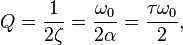
The quality factor (Q), damping ratio (ζ), attenuation rate (α), and exponential time constant (τ) are related such that:

Higher quality factor implies a lower attenuation rate, and so high-Q systems oscillate for many cycles.

Quality factors of common system

  • A unity gain Sallen–Key filter topology with equivalent capacitors and equivalent resistors is critically damped (i.e., $Q=0.5$)
  • A second order Butterworth filter (i.e., continuous-time filter with the flattest passband frequency response) has an underdamped Q = 1/\sqrt{2}.
  • A Bessel filter (i.e., continuous-time filter with flattest group delay) has an underdamped Q = 1/\sqrt{3}


Sources:
https://ccrma.stanford.edu/~jos/fp/Quality_Factor_Q.html
http://www.ece.ucsb.edu/Faculty/rodwell/Classes/ece218b/notes/Resonators.pdf
http://ocw.mit.edu/courses/electrical-engineering-and-computer-science/6-071j-introduction-to-electronics-signals-and-measurement-spring-2006/lecture-notes/resonance_qfactr.pdf


Transient and frequency response of R-L-C series Circuit

Prerequisites


Experiment Steps


  • Connect the circuit as per the experiment manual.

  • You know the value of L and C in the circuit. So find out the value of R for which the value of $\xi = 0.1$. Set the resistance accordingly.
  • Supply a square wave input voltage of  Vp = 1.5 v. 
  • Find the rise time, settling time, and the percentage overshoot from the CRO waveforms.
  • Repeat the experiment for $\xi = 0.2, 0.3, 0.5, 0.7, 0.8$.
  • Trace the output at two/three $\xi$ values. 
  • Plot the $\xi$~ percentage overshoot.

NEXT: (Frequency response)
  • Find the natural frequency of oscillation of the circuit ($f_0$).
  • Sweep the frequencies from $\frac{f_0}{10}$ to $10 f_0$. Record the output voltage($V_o$).
  • Also, record the phase difference of $V_o$ with respect to $V_i$ (in radian).
  • Calculate the following for each frequency: 
    Gain = $\frac{V_o}{V_i}$ 
    Gain in DB = $20 log \frac{V_o}{V_i}$
  • Plot the frequency ~ Gain in DB and frequency ~ phase difference in semilog graph paper.
