The quality factor (Q) describes how under-damped an oscillator or resonator is and characterizes a resonator's bandwidth relative to its center frequency.
The other common definition for Q is the ratio of the energy stored in the oscillating resonator to the energy dissipated per cycle by damping processes:

The case $Q=1/2$ is called critically damped, while $Q<1/2$ is called overdamped. A resonator ($Q>1/2$ ) is said to be underdamped, and the limiting case $Q=\inf $ is simply undamped.
For a two-pole lowpass filter, the transfer function of the filter is

For this system, when $Q>1/2$ (i.e., when the system is underdamped), it has two complex conjugate poles that each have a real part of
 . That is, the attenuation parameter
  represents the rate of exponential decay of the oscillations.
The poles of the transfer function $H(s)$ are given by

Therefore, the poles are complex only when $Q>1/2$. Since real poles do not resonate, we have $Q>1/2$ for any resonator.
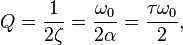
Higher quality factor implies a lower attenuation rate, and so high-Q systems oscillate for many cycles.
Quality factors of common system
- A unity gain Sallen–Key filter topology with equivalent capacitors and equivalent resistors is critically damped (i.e., $Q=0.5$)
- A second order Butterworth filter (i.e., continuous-time filter with the flattest passband frequency response) has an underdamped
 .
. - A Bessel filter (i.e., continuous-time filter with flattest group delay) has an underdamped

Sources:
https://ccrma.stanford.edu/~jos/fp/Quality_Factor_Q.html
http://www.ece.ucsb.edu/Faculty/rodwell/Classes/ece218b/notes/Resonators.pdf
http://ocw.mit.edu/courses/electrical-engineering-and-computer-science/6-071j-introduction-to-electronics-signals-and-measurement-spring-2006/lecture-notes/resonance_qfactr.pdf
