
fixed source resistance: RS
load resistance: RL


PL will be maximum, when the denominator
 will be minimum.
For a maximum or minimum, the first derivative is zero, so

or

The theorem results in maximum power transfer, and not maximum efficiency. If the resistance of the load is made larger than the resistance of the source, then efficiency is higher, since a higher percentage of the source power is transferred to the load, but the magnitude of the load power is lower since the total circuit resistance goes up.

We define the efficiency η as the ratio of power dissipated by the load to power developed by the source.

Consider three particular cases:
- If
 , then
- If
 or
or  then
then 
- If
 , then
In Reactive circuits:

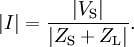

where the resistance  and reactance
  are the real and imaginary parts of
  , and
, and  is the imaginary part of
  .
.
and reactance are the real and imaginary parts of , and is the imaginary part of .
To determine the values of  and (since
  , , and are fixed) for which this expression is a maximum, we first find, for each fixed positive value of , the value of the reactive term for which the denominator
and (since , , and are fixed) for which this expression is a maximum, we first find, for each fixed positive value of , the value of the reactive term for which the denominator
is a minimum. Since reactances can be negative, this denominator is easily minimized by making

The power equation is now reduced to:
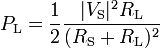
and it remains to find the value of which maximizes this expression. However, this maximization problem has exactly the same form as in the purely resistive case, and the maximizing condition  can be found in the same way.
which maximizes this expression. However, this maximization problem has exactly the same form as in the purely resistive case, and the maximizing condition can be found in the same way.
The combination of conditions


